Exposiciones Contemporáneo
Olinda Silvano. Nokon kenera jatibian biribirishamanai “Mi kené brilla al mundo”
Publicado el: 24/04/2026
- Fecha: 24/04/2026
- Hora: 10:00
- Lugar: Sala 29 del segundo piso del Museo de Arte de Lima
Nokon kenera jatibian biribirishamanai, “mi kené brilla al mundo”, presenta la primera exposición individual de Olinda Silvano Inuma, artista y activista shipibo konibo cuya obra ha concitado importante atención en el medio local, nacional e internacional. La frase que titula la exposición apuesta por la vigencia de la lengua y el kené shipibo konibo, como vehículos de memoria, y lugar desde donde se enuncia su obra. El kené, que revela a través de infinitas tramas geométricas el conocimiento de los sabios vegetalistas, en las últimas décadas ha ingresado al ecosistema del arte contemporáneo ampliando sus coordenadas geográficas hacia el mundo.
Si bien la exposición no sigue rigurosamente un orden cronológico, nos permite descubrir el camino que ha cursado su proceso creativo. Una de sus primeras incursiones, en el año 2011, se dio cuando compartió emprendimientos vinculados a la moda y al arte textil con la diseñadora Anabel de la Cruz. Posteriormente, su encuentro con el curador y antropólogo César Ramos Aldana (1963-2017), marcó un hito en torno a su autodescubrimiento como artista. A instancias de Ramos, Silvano conoció la canónica Escuela Nacional Superior Autónoma de Bellas Artes y la riqueza de sus propios conocimientos “tradicionales”, a menudo considerados equivocadamente opuestos o subalternos a la formación artística académica. A partir de ese momento se generaron conversaciones y colaboraciones con Julia Ortiz, Carolina Estrada, Harry Chávez, Augusto Ballardo, Pepe Corzo, Naty Muñoz, Julio Vega, entre otros creadores, quienes aportaron de maneras muy diversas al enriquecimiento de su lenguaje plástico, a la vez que establecieron con ella lazos afectivos.
Otro de los encuentros auspiciosos que generó Ramos fue el que tuvo con la antropóloga y artista Alejandra Ballón, con quien Silvano inició su incursión en la pintura mural el año 2015. Este nuevo medio no solo reconfiguró el kené y lo adaptó al ámbito urbano, sino que se convirtió en un modelo esperado de trabajo colaborativo, que dio lugar a la creación del Colectivo Soi Noma de pintoras muralistas. Conformado inicialmente por Wilma Maynas y Silvia Ricopa, el muralismo shipibo konibo se ha convertido en un movimiento artístico y político que las ha llevado a escenarios internacionales.
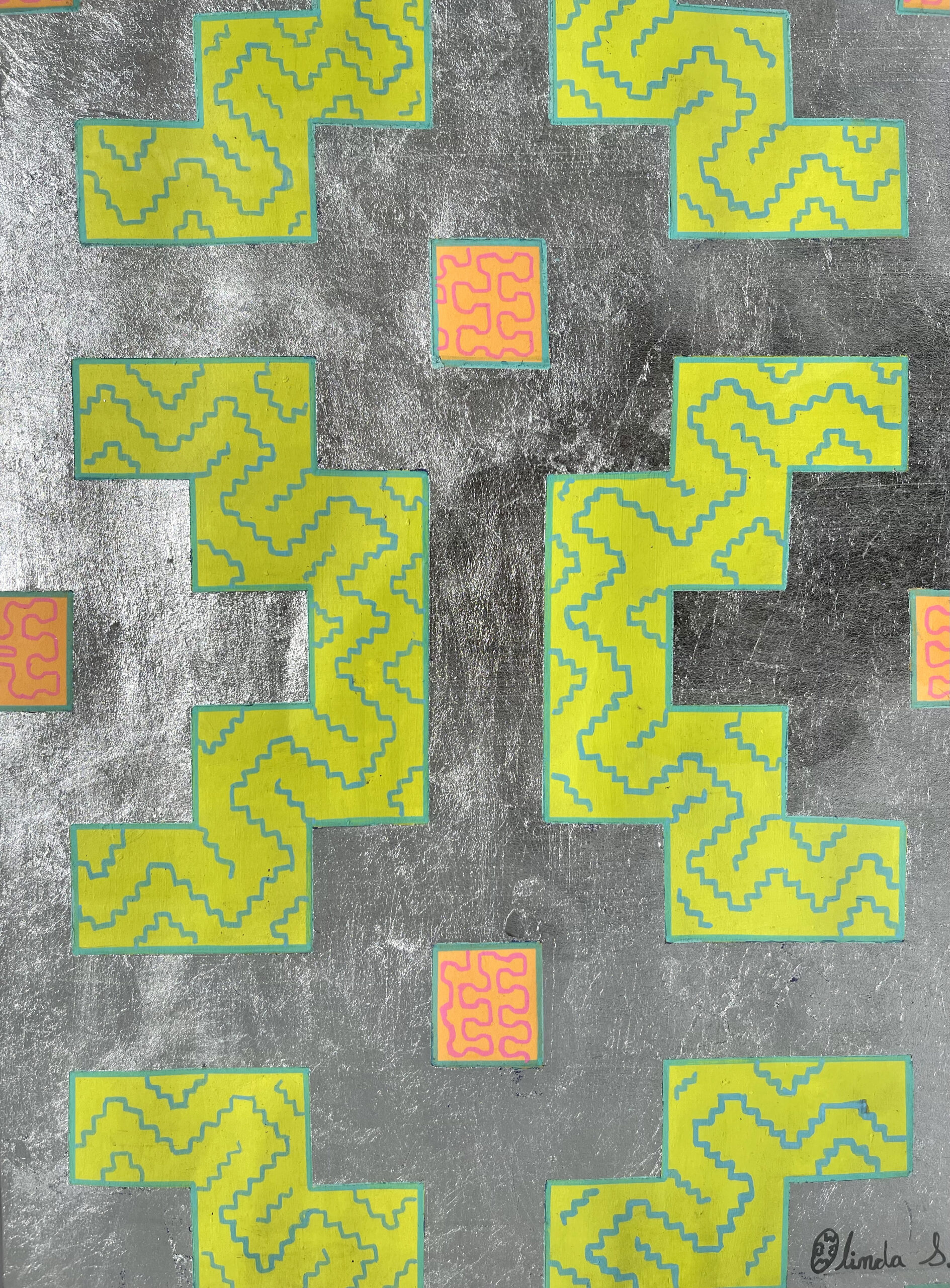
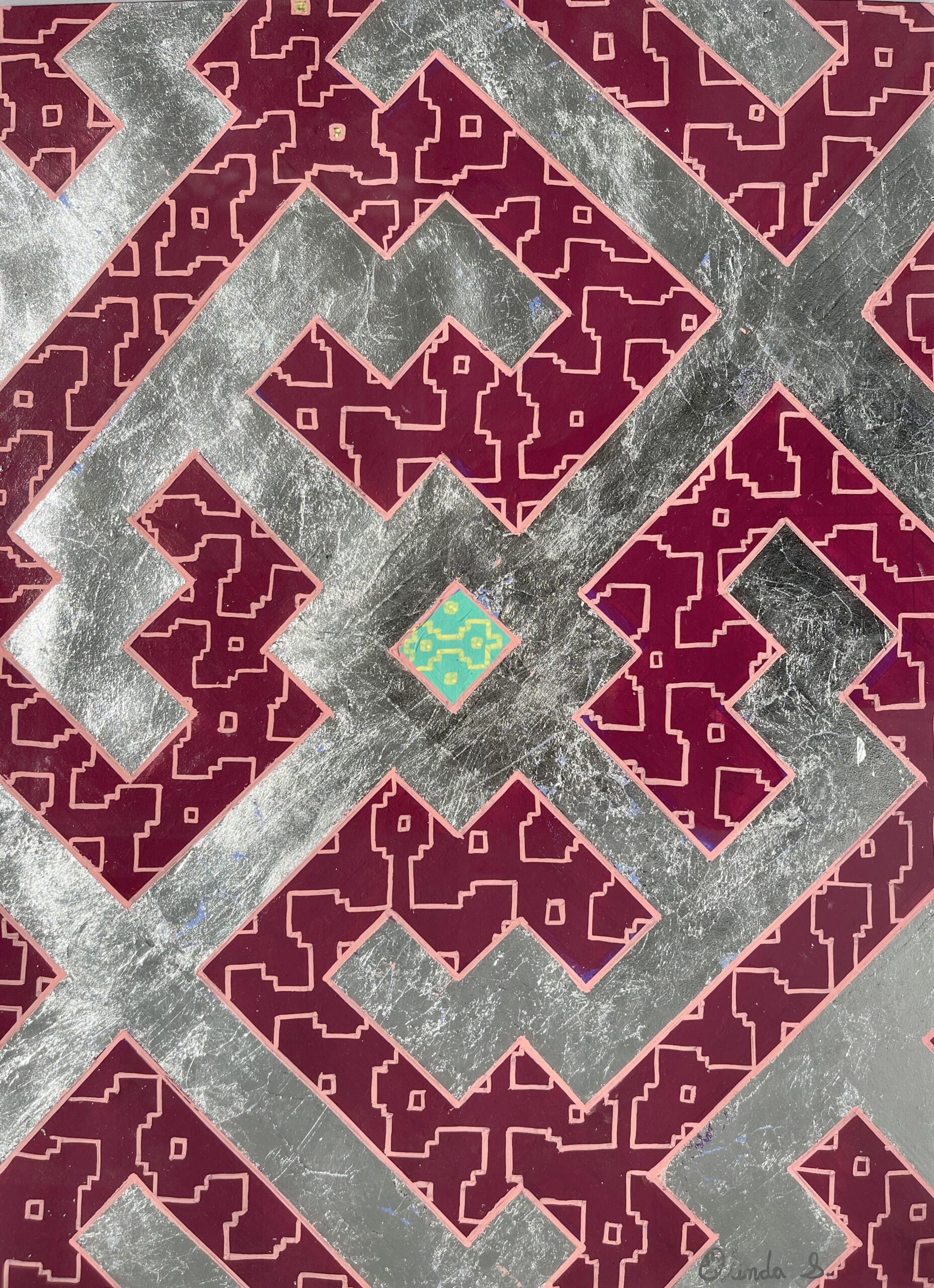
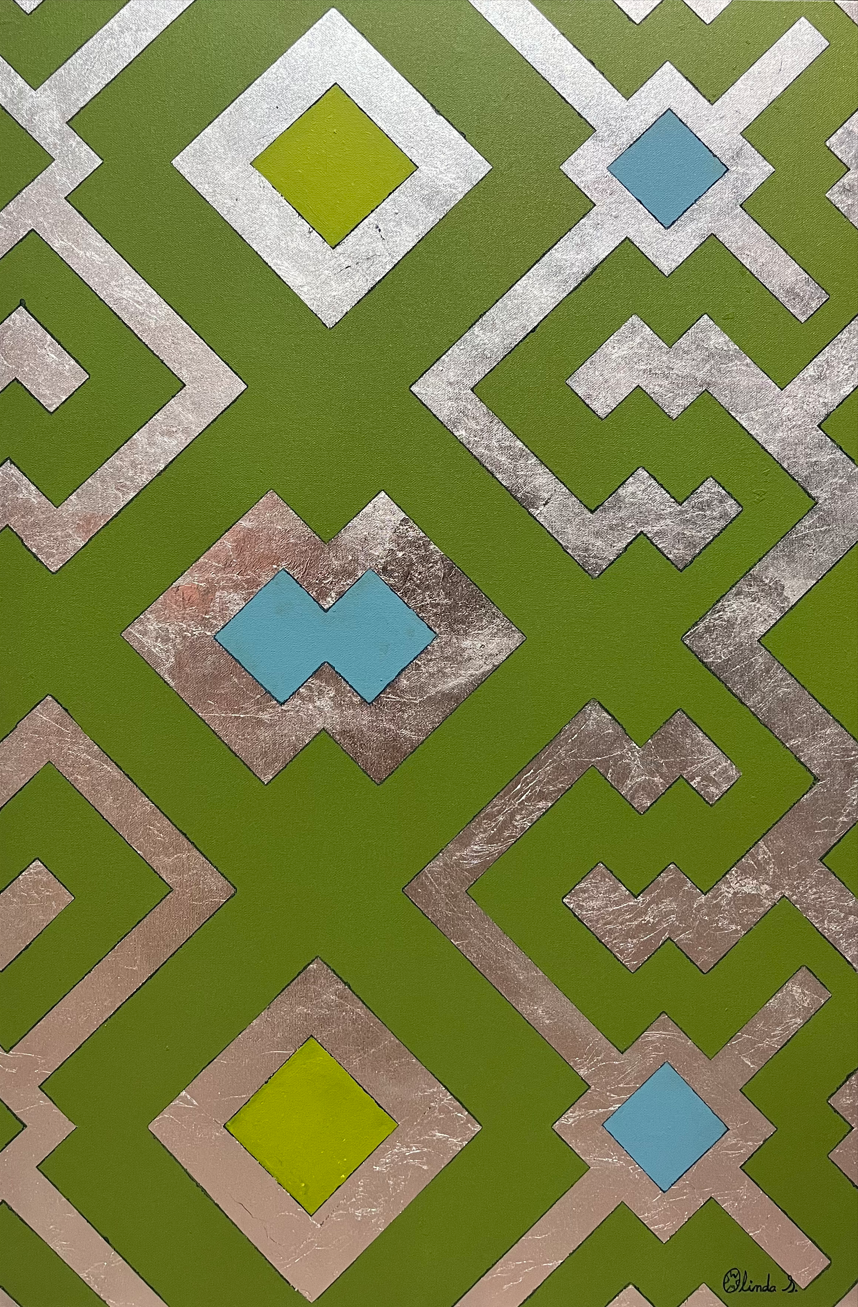
En los últimos años, las obras de Silvano, hechas junto a su hijo, el también artista Ronin Koshi, destacan por su geometrismo de colores planos, vibrantes, realizados con una precisión y cuidado notables. Este cambio responde a su participación en Río Corrientes, un laboratorio de arte dirigido por el artista Christian Bendayán, en donde ha empezado a trabajar nuevos formatos y técnicas, como la serigrafía. En este contexto, Olinda ha logrado materializar el brillo que caracteriza su kené, a través de la incorporación de pan de oro y pan de plata, dando cuenta de su infinito potencial.
A lo largo de la muestra veremos como la materialidad de sus obras y su lenguaje va desde el uso de pigmentos naturales, con los que narró sus primeros relatos visuales testimoniales, hacia el descubrimiento de insumos industriales, acrílicos, objetos y texturas diversas con las que expandió el kené y su cromatismo.
Como las demás mujeres shipibo konibo residentes en Cantagallo, Olinda trabajó durante mucho tiempo como vendedora ambulante de artesanías en la ciudad de Lima. Aquí vivió la invisibilización, la discriminación y el rechazo, experiencias que permiten valorar la influencia e importancia que tiene hoy su nombre y a repensar en torno a los límites tan imprecisos que definen lo artesanal y lo artístico. Aunque la obra de Olinda Silvano —o Reshin Jabe, su nombre shipibo konibo que significa “primer suspiro”—celebra la perdurabilidad de una visualidad milenaria, el vibrante colorido y el brillo de su kené, nos convoca también a defender el derecho a conocer y aprender de esas ontologías ancestrales, como la shipibo konibo y, a alcanzar para todas las formas de vida, una existencia digna.
Curadora: María Eugenia Yllia
- Olinda Silvano Inuma Reshin Jabe (Paoyhan, Padre Márquez, Loreto, 1969) Sin título Untitled 2025 Acrílico y pan de plata sobre papel 56 x 41 cm c/u Cortesía Taller Río Corrientes
- Olinda Silvano Inuma Reshin Jabe (Paoyhan, Padre Márquez, Loreto, 1969) Sin título Untitled 2025 Acrílico y pan de plata sobre papel 56 x 41 cm c/u Cortesía Taller Río Corrientes
- Olinda Silvano Inuma Reshin Jabe (Paoyhan, Padre Márquez, Loreto, 1969) Sin título Untitled 2025 Acrílico y platino sobre tela 95 x 67,3 cm Cortesía Taller Río Corrientes
“Nokon kenera jatibian biribirishamanai” iki ikatoninra peokin onamai Olinda Silvano Inuma menin itan ninkakatai Shipibo-Konibo ainbo, jawen aka teebaon manaikanai nekebi itan nato netemeabo. Jato ninkamanoxon janea wishakanra , non joi itan ja kene shipibo- konibo rama kamanbi japaria ixon onamaxon jato tsinkiai, jan joti baikiranakesaakin shinanti, itan ja itinaimeranxon nato menin ainbonin jato ninkamai jawen tee akabo. Ja kene kanoabomeran, mesko keyotimabireskeska kenebo oimai, ja jiwi raomea onana jonibaon samataboo. Nato chonka baritiabo winotameranra menin jonibaon ramatian akaimeran jikike, janra wetsanko noa ocho boke nato nete mayakin.
Nato non onamai jawekinin toponbokin chibanyamai, ikaxbi noa meramai ja bai jaskaaxon kenebo pikokana. Rekenbires neskarabo akin peowa iki 2011 baritian, jatian jato onama iki jawen akin peowa jawekibo chopa mesko kewe akin, ja chopa mesko ati ona Anabel de la Cruz betan. Ja pekao, nokoanana iki benxoamis itan jonibo onanai Cesar Ramos Aldana betan (1963-2017) Jainoax peokota iki, shinameti jawen menin ixon atipana jawekibo jakoakin oinkin. Ramos ninra chania iki Olinda, jainxonra onana iki Escuela Nacional Autonoma de Bellas Artes, jainxonra mera iki jawen onana jawekibo “abeirana” jakomaakin yoikana iki non akabo jawemabishokobo, kirika akabaon saamaxon aka keskama akin noa yoinanakana iki. Jainoax yoyo iki peokokanai, akinanankanai Julia Ortiz, Carolina Estrada, Harry Chávez, Augusto Ballardo, Pepe Corzo, Naty Muñoz, Julio Vega betan, itan wetsa kene pikoaibobetan, jabaon ake mesko akin pikokin jaskaakin keweatibo, jainoaxribi jatoki noa axeke, jato non noike.
Wetsa tsinkiti Ramosnin ariba iki jonibo onanai itan menin ainbo Alejandra Ballón betan, jato betan Silvano nin kene akaibora oinxonres itan ninkaxonres janbishoko onantana xewama iki, kenekan ewabo akin peowa, ja ika iki 2015 baritian. Nato bena jaweki nokoatonin nona bicho kewearestima ika iki, peokota iki nawabaon jema ikaninko kewe ati, jatianribi peokota iki akinanani teeti, jaskarainoax pikotai tsinkitax teeti Soi Noma, kenekan ewa akaibo. Ja ika iki Wilma Maynas betan Silvia Ricopa nin peoni jaweki, jainoax tsinkiti peokota iki jaskara tee akaibobiri itan koshi joi pikoaibo, jaskaraton jato boa iki nete mayakin.
Nato bariria winotabaon, Olinda nin ramachabi tee aka iki, jawen bake betan, Ronin Koshi janeya, menin bake, jishtiai mesko kene kikin sikayabo itan sankenshamanbo, oinshamanxon, ponteshamanbo itan koiranxon akabo onantibires, jankea sankenshamanbo. Nato tee aka jaskara benabo iki rio Corrientes ikain kaxon jaskaatibo, onana kopi, ja iki Christian Bendayán menin jonin jato akinai, jain teeta iki bena jisa jawekibo aki itan bena akin mayatibo onana iki, chopaki bitaxon keneatibo onana iki. Neskara meranxon Olinda nin mera iki jawen kenebo peneshamanbo imakin, kori itan koriki keska penetaibaon sikakin, rama oina iki keyotima keska anibires jakoinra jaweki neskarabaon kene aka.
Nato tee onamaboaimeranra non oinai, jawekeskarainoaxki ja nekebi itina jaweki itan jawen joimeran yoiaibo jishtiai ixon, jawen nekeabi sikatibo, janpari akin peowa ixonbi, janpari noa ninkamabo ixonbi, nawabaon jan sikati pikoabo mera iki, tsosinbo, xepanbo itan mesko pakexbo, janskaraboan axon ocho bokin peowa iki non kene itan jawen mesko sikabo.
Jatiribi ainbobo Canta Gallo jeman jabo keskaribi, Olinda teeta iki icha baritia sananax jawen akabo maroi Lima jemanko. Neno onana iki noa oinama keska ikanaibo, omiskanti, non kenyamakanai jawekibo, neskarabo winoxon onanai jawerano kamanki atipana ixon jaskaribi jawen jane rabiti itan ikoankanti. Jainxon shinanribiti iki jawerano kamanki senena ja manaiti itan meninbaon aka jawekibo jaimatani akin yoikanaibo.Olinda– Reshin Jabe jawen janekon “primer suspiro” iki ika nawan join. Ibanon jawen tee keyotimabires, jawetianbira akanani merakin, ja sanken akin akabo, ja peneshamanbo kene, jaskaratonra noa chaniai noa jayata jawekibo koiranti, jainxonribi onanti itan samati ja non rekenbaon jaomea onanabo, noa Shipibo Konibo ixon non onana itibo jaskatax jakoni jati netebo non nokoti kopi.
Traducción al shipibo-konibo: Lener Guimaraes
Nokon Kenera Jatibian Biribirishamanai, “My Kené Shines to the World”, presents the first solo exhibition by Olinda Silvano Inuma, Shipibo Konibo artist and activist whose work has attracted important attention by local, national, and international media. The phrase that titles the exhibition puts faith in the continued importance of the Shipibo Konibo language and kené as vehicles of memory, and a place from which her work is expressed. Kené, which through its infinite geometric weaves reveals the knowledge of the wise vegetalists, in the last decades has entered the contemporary art ecosystem, widening its geographic coordinates to the world.
Although the exhibition does not follow a rigorous chronological order, it allows us to discover the path that has followed her creative process. One of her first incursions, in the year 2011, happened when she shared ventures linked to fashion and textile art with the designer Anabel de la Cruz. Later, her meeting with the curator and anthropologist César Ramos Aldana (1963-2017), was a landmark moment in her self discovery as an artist. By Ramos’ request, Silvano got to know the canonical Escuela Nacional Superior Autónoma de Bellas Artes and the richness of her own “traditional” knowledge, often mistakenly considered opposite or subordinate to academic artistic training. From this moment, conversations and collaborations were generated with Julia Ortiz, Carolina Estrada, Harry Chávez, Augusto Ballardo, Pepe Corzo, Naty Muñoz, Julio Vega, among other creators, who contributed in very diverse ways to the enrichment of her visual language, at the same time that they established affective links to her.
Another of these auspicious encounters generated by Ramos was the one she had with the anthropologist and artist Alejandra Ballón, with whom Silvano began her incursion into mural painting in the year 2015. This new medium not only reconfigured kené and adapted it to an urban environment, but also became a model of collaborative work, which resulted in the creation of the Soi Noma Collective of muralist painters. Initially made up by Wilma Maynas and Silvia Ricopa, Shipibo Konibo muralism has become an artistic and political movement that has taken them to the international stage.
In recent years, Silvano’s work, made together with her son, the artist Ronin Koshi, stand out for their geometrism of plain and vibrant colors, created with notable precision and care. This change responds to her participation in Río Corrientes, an art laboratory directed by the artist Christian Bendayán, where she has begun working with new formats and techniques like screen printing. In this context, Olinda was able to materialize the shine that characterizes her kené through the incorporation of gold and silver leaf, testifying to her infinite potential.
Throughout the exhibit we see how the materiality of her work and her language ranges from the use of natural pigments, with which she narrated her first testimonial visual accounts, to the discovery of industrial materials, acrylics, objects, and diverse textures with which she expanded kené and her use of colors.
Like other Shipibo Konibo women residing in Cantagallo, Olinda worked for a long time as a street vendor selling artisan works in the city of Lima. Here she experienced invisibilization, discrimination, and rejection, experiences that allow the appreciation of the influence and importance that her name has today, and the rethinking of the imprecise limits that define artisanry and art. Although the work of Olinda Silvano – or Reshin Jabe, her name in Shipibo Konibo which means “first sigh” – celebrates the endurance of a millenarian visuality, the vibrant colorfulness and shine of her kené, calls upon us to also defend the right to know and learn about these ancestral ontologies, like the Shipibo Konibo, and to achieve for all forms of life, a dignified existence.
Curator: María Eugenia Yllia